
Target Questions & Arithmetic Missions
Build, practise and secure the arithmetic skills pupils need for SATs success.
Arithmetic Target Questions : Identify & address gaps.
Arithmetic Missions : Practise & support the sills needed for paper 1.
Target Questions + Missions : Build confidence secure fluency and boost scores.
Arithmetic Target Questions
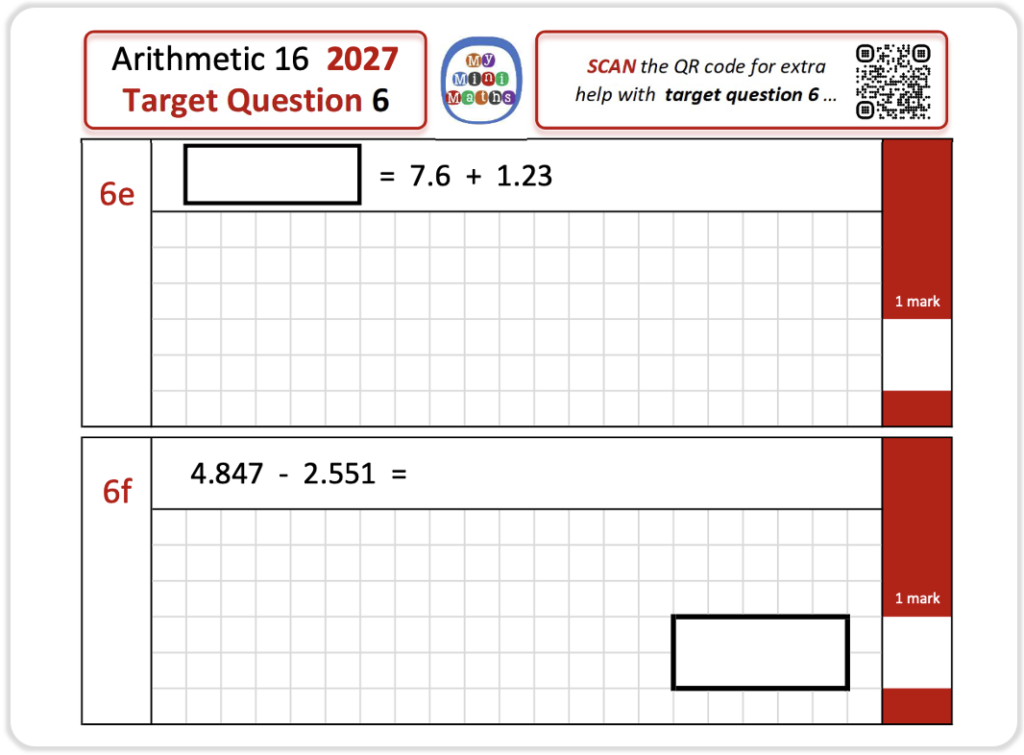
Identify gaps, target specific skills and provide focused practice - Updated for 2027.
Arithmetic Missions
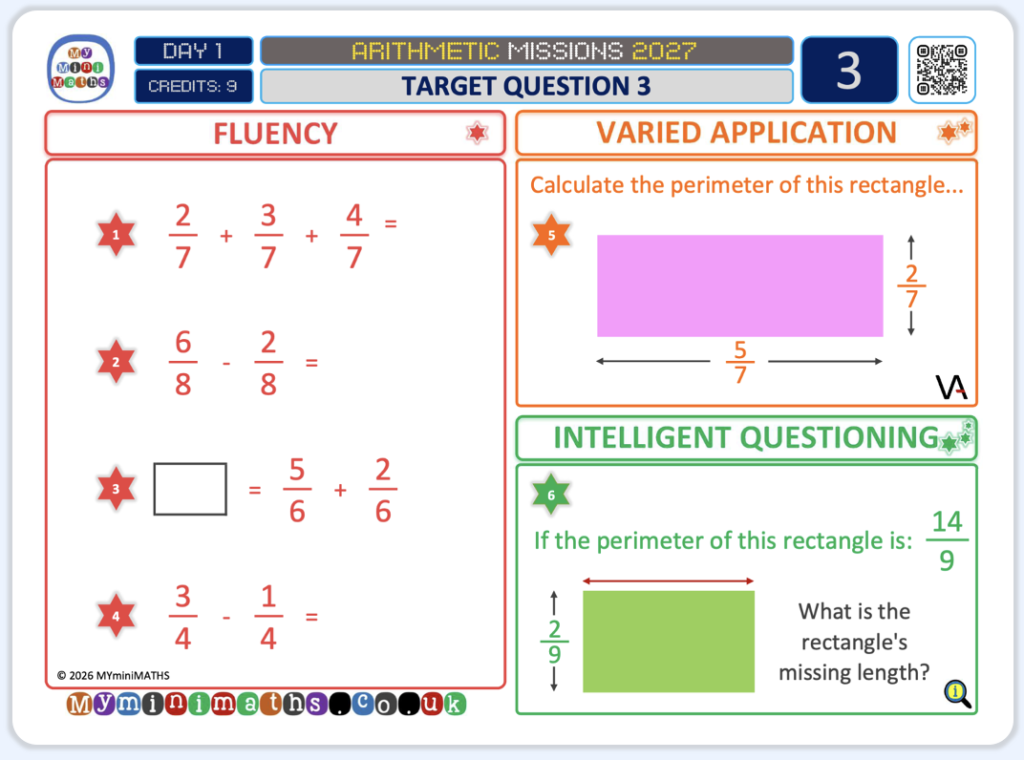
Secure foundation skills, make connections and apply arithmetic through challenge.
TQ Profile Scores
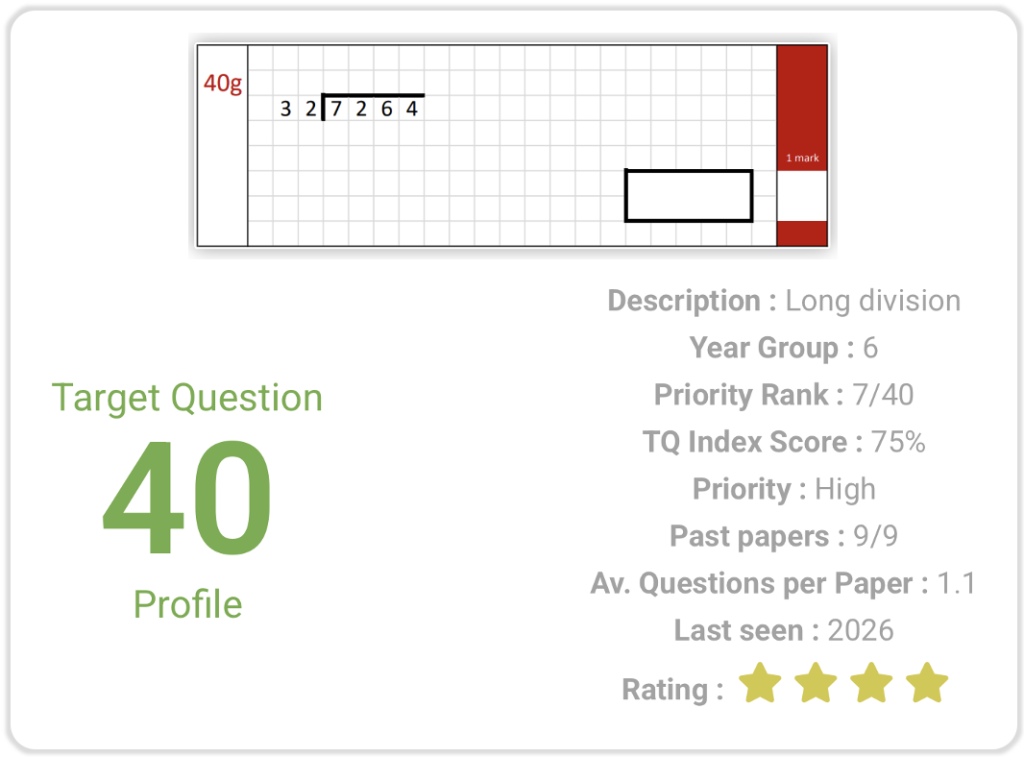
See how each arithmetic skill is rated, prioritised and supported to help you identify where pupils need further practice.
40 Arithmetic Targeted Resources
Please use the filter & search features below to find your required target questions...
| TQ | Description | Year Group | Priority Rank | TQ Index Score | Priority | Past papers | Av. Q per paper | Last seen | Star Rating | GO |
|---|---|---|---|---|---|---|---|---|---|---|
| 1 | Multiplying 3 values together | 4 | 28/40 | 35% | Develop | 5/9 | 1 | 2025 | 2 | GO |
| 2 | Formal addition with 2, 3 & 4 digit values of mixed length | 4 | 10/40 | 68% | High | 8/9 | 1.6 | 2026 | 4 | |
| 5 | Formal subtraction with 2, 3 & 4 digit values of mixed length | 4 | 30/40 | 30% | Develop | 4/9 | 1.8 | 2024 | 2 | |
| 3 | Adding & subtracting fractions with common denominators | 4 | 31/40 | 27% | Develop | 4/9 | 1.3 | 2026 | 2 | |
| 4 | Multiplying by 1 and 0 & Dividing by 1 | 4 | 22/40 | 47% | Medium | 7/9 | 1 | 2026 | 3 | |
| 6 | Adding & subtracting decimals of mixed length | 6 Higher | 4/40 | 81% | Very High | 9/9 | 1.6 | 2026 | 5 | |
| 7 | Place value and identifying the value of digits in numbers | 5 | 23/40 | 46% | Medium | 5/9 | 1 | 2026 | 3 | GO |
| 8 | Formal addition & subtraction with 1, 2 and 3 digit values of mixed length | 4 | 34/40 | 19% | Develop | 3/9 | 1 | 2025 | 2 | |
| 9 | Division using times tables facts | 4 | 1/40 | 100% | Essential | 9/9 | 3 | 2026 | 5 | |
| 10 | Short multiplication with 2 & 3 digit values | 4 | 3/40 | 84% | Very High | 9/9 | 1.9 | 2026 | 5 | |
| 11 | Adding and subtracting 4, 5, & 6 digit values of equal length | 6 | 16/40 | 49% | Medium | 7/9 | 1.3 | 2026 | 3 | |
| 12 | Adding and subtracting mixed numbers & fractions with related denominators | 5 | 32/40 | 24% | Develop | 4/9 | 1 | 2024 | 2 | GO |
| 13 | Adding and subtracting powers of 10 to values | 4 | 25/40 | 43% | Develop | 7/9 | 1.4 | 2026 | 2 | |
| 14 | BIDMAS order of operations | 6 | 33/40 | 21% | Develop | 5/9 | 1 | 2023 | 2 | |
| 15 | Multiplying fractions | 5 | 17/40 | 49% | Medium | 5/9 | 1.2 | 2026 | 3 | |
| 16 | Long division of 2 digit & 3 digit values | 6 | 8/40 | 73% | High | 9/9 | 1 | 2026 | 4 | |
| 17 | Multiplying by powers of 10 using times tables facts | 5 | 37/40 | 9% | Develop | 2/9 | 1 | 2017 | 2 | |
| 18 | Short division of 2 digit, 3 digit & 4 digit values | 5 | 11/40 | 66% | High | 7/9 | 1.7 | 2026 | 4 | |
| 19 | Dividing decimals by powers of 10 | 5 | 9/40 | 73% | High | 9/9 | 1 | 2026 | 4 | |
| 20 | Multiplying values by powers of 10 | 5 | 20/40 | 48% | Medium | 7/9 | 1.3 | 2026 | 3 | |
| 21 | Whole number subtract a decimal | 5 | 21/40 | 48% | Medium | 7/9 | 1.4 | 2025 | 3 | |
| 22 | Long multiplication of 3 & 4 digit values | 5 | 2/40 | 87% | Very High | 9/9 | 2 | 2026 | 5 | |
| 23 | BIDMAS Order of operations with indices | 6 | 14/40 | 52% | Medium | 6/9 | 1.2 | 2026 | 3 | |
| 24 | Adding and subtracting mixed numbers | 6 Higher | 27/40 | 37% | Develop | 4/9 | 1.5 | 2026 | 2 | |
| 25 | Adding and subtracting fractions with related denominators | 5 | 12/40 | 64% | High | 8/9 | 1.1 | 2026 | 4 | |
| 26 | Whole numbers subtract mixed numbers | 6 Higher | 39/40 | 4% | Develop | 1/9 | 1.6 | 2022 | 2 | |
| 27 | Formal addition of 3 digit & 4 digit values of mixed length | 5 | 36/40 | 17% | Develop | 2/9 | 1 | 2026 | 2 | |
| 28 | 2 digit numbers multiplied by decimals | 5 | 13/40 | 59% | Medium | 7/9 | 1.3 | 2026 | 3 | |
| 29 | Adding 3 fractions with related denominators | 5 | 35/40 | 19% | Develop | 3/9 | 1 | 2025 | 2 | |
| 30 | Fractions divided by whole numbers | 5 | 5/40 | 78% | Very High | 9/9 | 1.3 | 2026 | 5 | |
| 31 | Adding and subtracting powers of 10 | 5 | 40/40 | 4% | Develop | 1/9 | 1 | 2022 | 2 | |
| 32 | Percentage of an amount in multiples of 10% | 5 | 26/40 | 38% | Develop | 7/9 | 1 | 2026 | 2 | |
| 33 | Adding and subtracting mixed numbers & fractions with unrelated denominators | 6 | 18/40 | 49% | Medium | 8/9 | 1.1 | 2025 | 3 | |
| 34 | Fractions of an amount | 5 | 19/40 | 48% | Medium | 7/9 | 1.1 | 2026 | 3 | |
| 35 | Percentage of an amount in multiples of 1% | 6 Higher | 6/40 | 75% | High | 8/9 | 1.6 | 2026 | 4 | |
| 36 | Adding and subtracting denominators with unrelated denominators | 6 | 29/40 | 31% | Develop | 5/9 | 1.4 | 2024 | 2 | |
| 37 | Adding fractions to make one whole | 3 | 38/40 | 6% | Develop | 1/9 | 2 | 2023 | 2 | |
| 38 | Percentages of an amount in multiples of 5% | 6 | 24/40 | 44% | Develop | 6/9 | 1.2 | 2026 | 2 | |
| 39 | Multiplying mixed numbers and 2 digit values | 6 | 15/40 | 51% | Medium | 6/9 | 1 | 2026 | 3 | |
| 40 | Long division of 4 digit by 2 digit values | 6 | 7/40 | 75% | High | 9/9 | 1.1 | 2026 | 4 |
Ready to add MYminiMATHS+ to your classroom?
Join thousands of teachers already using MYminiMATHS+.

Arithmetic Target Questions
Target specific arithmetic skills with focused, SATs-style practice.
The MYminiMATHS+ Arithmetic Target Questions provide a structured way to identify, practise and secure the key arithmetic skills pupils need for SATs.
Each Target Question focuses on a specific mathematical skill and provides opportunities for pupils to revisit the concept, practise the calculation and develop confidence.
Use the Target Questions alongside the Arithmetic Tracker to identify areas that require further practice and quickly select appropriate resources.
Arithmetic Missions
Build fluency, make connections and deepen mathematical understanding.
Arithmetic Missions provide structured, progressive practice that begins with fluency questions to secure essential arithmetic skills. Pupils then apply these skills in different mathematical contexts, making connections between arithmetic and other areas of the curriculum.
Each mission also includes challenge questions designed to deepen understanding and application, encouraging pupils to reason with their arithmetic knowledge rather than simply perform calculations.
This combination of fluency, connections and challenge helps pupils develop secure skills, flexible thinking and greater confidence when applying mathematics.
Understanding Target Question Profile Scores
Use the TQ Profile to understand the importance of each arithmetic skill, identify priorities and plan focused practice — while ensuring pupils have opportunities to cover all 40 Target Questions.
Each Arithmetic Target Question is supported by a range of information designed to help teachers understand the significance of each skill, identify areas for further practice and make informed decisions about where to focus teaching and intervention.
The profile scores can help you prioritise skills based on factors such as their frequency in past SATs papers, how recently they have appeared and their overall rating. However, the scores are designed to guide your planning rather than limit the range of skills pupils practise.
Why cover all 40 Target Questions?
The 40 Target Questions provide coverage of the key arithmetic skills assessed across KS2 SATs. While some skills may have a higher priority or appear more frequently, every Target Question represents an important aspect of arithmetic understanding.
Target Question
40
Profile
Description : Long division
Year Group : 6
Priority Rank : 7/40
TQ Index Score : 75%
Priority : High
Past papers : 9/9
Av. Questions per Paper : 1.1
Last seen : 2026
Rating :

Target Question :
One of 40 arithmetic skills that together cover every question type seen in published KS2 Arithmetic SATs papers since 2016.
Description :
A brief summary of the arithmetic skill assessed by this Target Question.
Year Group :
The National Curriculum year in which this skill is typically taught.
Priority Rank :
This Target Question’s position (1–40) based on its historical importance across published KS2 Arithmetic SATs papers.
TQ Index Score :
An evidence-based score showing the historical relevance of this Target Question, calculated from published SATs papers since 2016.
Priority :
A simple guide to how much emphasis teachers should place on this Target Question during SATs preparation.
Past papers :
The number of published KS2 Arithmetic papers (out of 9) in which this Target Question has appeared.
Av. Questions per Paper :
The average number of questions assessing this Target Question in each published KS2 Arithmetic SATs paper in which it appears.
Last Seen :
The most recent published KS2 Arithmetic paper in which this Target Question appeared.
Rating :
A five-star summary of the Target Question’s overall historical importance and relevance for SATs preparation.
Please note: The Target Question Profile is based on analysis of all published KS2 Arithmetic SATs papers since 2016 (excluding 2020 and 2021). It is intended to help inform SATs preparation by identifying historical patterns and priorities. As future assessment papers are developed independently, the appearance of any Target Question cannot be guaranteed and should not be interpreted as a prediction of future assessments.
Build, practise and secure the arithmetic skills pupils need for SATs success.
Arithmetic Target Questions
Target key skills, identify gaps and build secure arithmetic knowledge.
Arithmetic Missions
Build fluency, make connections and deepen understanding through application.
TQ Profile Scores
Understand priorities, track key skills and plan targeted practice.
Unlock 1,700+ Premium Resources
Arithmetic Target Questions & Missions
Please use the filter & search features below to find your required target questions...
| TQ | Description | Year Group | Priority Rank | TQ Index Score | Priority | Past papers | Av. Q per paper | Last seen | Star Rating | GO |
|---|---|---|---|---|---|---|---|---|---|---|
| 1 | Multiplying 3 values together | 4 | 28/40 | 35% | Develop | 5/9 | 1 | 2025 | 2 | GO |
| 2 | Formal addition with 2, 3 & 4 digit values of mixed length | 4 | 10/40 | 68% | High | 8/9 | 1.6 | 2026 | 4 | |
| 5 | Formal subtraction with 2, 3 & 4 digit values of mixed length | 4 | 30/40 | 30% | Develop | 4/9 | 1.8 | 2024 | 2 | |
| 3 | Adding & subtracting fractions with common denominators | 4 | 31/40 | 27% | Develop | 4/9 | 1.3 | 2026 | 2 | |
| 4 | Multiplying by 1 and 0 & Dividing by 1 | 4 | 22/40 | 47% | Medium | 7/9 | 1 | 2026 | 3 | |
| 6 | Adding & subtracting decimals of mixed length | 6 Higher | 4/40 | 81% | Very High | 9/9 | 1.6 | 2026 | 5 | |
| 7 | Place value and identifying the value of digits in numbers | 5 | 23/40 | 46% | Medium | 5/9 | 1 | 2026 | 3 | GO |
| 8 | Formal addition & subtraction with 1, 2 and 3 digit values of mixed length | 4 | 34/40 | 19% | Develop | 3/9 | 1 | 2025 | 2 | |
| 9 | Division using times tables facts | 4 | 1/40 | 100% | Essential | 9/9 | 3 | 2026 | 5 | |
| 10 | Short multiplication with 2 & 3 digit values | 4 | 3/40 | 84% | Very High | 9/9 | 1.9 | 2026 | 5 | |
| 11 | Adding and subtracting 4, 5, & 6 digit values of equal length | 6 | 16/40 | 49% | Medium | 7/9 | 1.3 | 2026 | 3 | |
| 12 | Adding and subtracting mixed numbers & fractions with related denominators | 5 | 32/40 | 24% | Develop | 4/9 | 1 | 2024 | 2 | GO |
| 13 | Adding and subtracting powers of 10 to values | 4 | 25/40 | 43% | Develop | 7/9 | 1.4 | 2026 | 2 | |
| 14 | BIDMAS order of operations | 6 | 33/40 | 21% | Develop | 5/9 | 1 | 2023 | 2 | |
| 15 | Multiplying fractions | 5 | 17/40 | 49% | Medium | 5/9 | 1.2 | 2026 | 3 | |
| 16 | Long division of 2 digit & 3 digit values | 6 | 8/40 | 73% | High | 9/9 | 1 | 2026 | 4 | |
| 17 | Multiplying by powers of 10 using times tables facts | 5 | 37/40 | 9% | Develop | 2/9 | 1 | 2017 | 2 | |
| 18 | Short division of 2 digit, 3 digit & 4 digit values | 5 | 11/40 | 66% | High | 7/9 | 1.7 | 2026 | 4 | |
| 19 | Dividing decimals by powers of 10 | 5 | 9/40 | 73% | High | 9/9 | 1 | 2026 | 4 | |
| 20 | Multiplying values by powers of 10 | 5 | 20/40 | 48% | Medium | 7/9 | 1.3 | 2026 | 3 | |
| 21 | Whole number subtract a decimal | 5 | 21/40 | 48% | Medium | 7/9 | 1.4 | 2025 | 3 | |
| 22 | Long multiplication of 3 & 4 digit values | 5 | 2/40 | 87% | Very High | 9/9 | 2 | 2026 | 5 | |
| 23 | BIDMAS Order of operations with indices | 6 | 14/40 | 52% | Medium | 6/9 | 1.2 | 2026 | 3 | |
| 24 | Adding and subtracting mixed numbers | 6 Higher | 27/40 | 37% | Develop | 4/9 | 1.5 | 2026 | 2 | |
| 25 | Adding and subtracting fractions with related denominators | 5 | 12/40 | 64% | High | 8/9 | 1.1 | 2026 | 4 | |
| 26 | Whole numbers subtract mixed numbers | 6 Higher | 39/40 | 4% | Develop | 1/9 | 1.6 | 2022 | 2 | |
| 27 | Formal addition of 3 digit & 4 digit values of mixed length | 5 | 36/40 | 17% | Develop | 2/9 | 1 | 2026 | 2 | |
| 28 | 2 digit numbers multiplied by decimals | 5 | 13/40 | 59% | Medium | 7/9 | 1.3 | 2026 | 3 | |
| 29 | Adding 3 fractions with related denominators | 5 | 35/40 | 19% | Develop | 3/9 | 1 | 2025 | 2 | |
| 30 | Fractions divided by whole numbers | 5 | 5/40 | 78% | Very High | 9/9 | 1.3 | 2026 | 5 | |
| 31 | Adding and subtracting powers of 10 | 5 | 40/40 | 4% | Develop | 1/9 | 1 | 2022 | 2 | |
| 32 | Percentage of an amount in multiples of 10% | 5 | 26/40 | 38% | Develop | 7/9 | 1 | 2026 | 2 | |
| 33 | Adding and subtracting mixed numbers & fractions with unrelated denominators | 6 | 18/40 | 49% | Medium | 8/9 | 1.1 | 2025 | 3 | |
| 34 | Fractions of an amount | 5 | 19/40 | 48% | Medium | 7/9 | 1.1 | 2026 | 3 | |
| 35 | Percentage of an amount in multiples of 1% | 6 Higher | 6/40 | 75% | High | 8/9 | 1.6 | 2026 | 4 | |
| 36 | Adding and subtracting denominators with unrelated denominators | 6 | 29/40 | 31% | Develop | 5/9 | 1.4 | 2024 | 2 | |
| 37 | Adding fractions to make one whole | 3 | 38/40 | 6% | Develop | 1/9 | 2 | 2023 | 2 | |
| 38 | Percentages of an amount in multiples of 5% | 6 | 24/40 | 44% | Develop | 6/9 | 1.2 | 2026 | 2 | |
| 39 | Multiplying mixed numbers and 2 digit values | 6 | 15/40 | 51% | Medium | 6/9 | 1 | 2026 | 3 | |
| 40 | Long division of 4 digit by 2 digit values | 6 | 7/40 | 75% | High | 9/9 | 1.1 | 2026 | 4 |
40 Arithmetic Target Questions
Target specific arithmetic skills with focused, SATs-style practice
The MYminiMATHS+ Arithmetic Target Questions provide a structured way to identify, practise and secure the key arithmetic skills pupils need for SATs.
Each Target Question focuses on a specific mathematical skill and provides opportunities for pupils to revisit the concept, practise the calculation and develop confidence.
Use the Target Questions alongside the Arithmetic Tracker to identify areas that require further practice and quickly select appropriate resources.
Arithmetic Missions
Build fluency, make connections and deepen mathematical understanding.
Arithmetic Missions provide structured, progressive practice that begins with fluency questions to secure essential arithmetic skills. Pupils then apply these skills in different mathematical contexts, making connections between arithmetic and other areas of the curriculum.
Each mission also includes challenge questions designed to deepen understanding and application, encouraging pupils to reason with their arithmetic knowledge rather than simply perform calculations.
This combination of fluency, connections and challenge helps pupils develop secure skills, flexible thinking and greater confidence when applying mathematics.
Understanding TQ Profile Scores
Use the TQ Profile to understand the importance of each arithmetic skill, identify priorities and plan focused practice — while ensuring pupils have opportunities to cover all 40 Target Questions.
Each Arithmetic Target Question is supported by a range of information designed to help teachers understand the significance of each skill, identify areas for further practice and make informed decisions about where to focus teaching and intervention.
The profile scores can help you prioritise skills based on factors such as their frequency in past SATs papers, how recently they have appeared and their overall rating. However, the scores are designed to guide your planning rather than limit the range of skills pupils practise.
Why cover all 40 Target Questions?
The 40 Target Questions provide coverage of the key arithmetic skills assessed across KS2 SATs. While some skills may have a higher priority or appear more frequently, every Target Question represents an important aspect of arithmetic understanding.
Target Question
40
Profile
Description : Long division
Year Group : 6
Priority Rank : 7/40
TQ Index Score : 75%
Priority : High
Past papers : 9/9
Av. Questions per Paper : 1.1
Last seen : 2026
Rating :
Target Question :
One of 40 arithmetic skills that together cover every question type seen in published KS2 Arithmetic SATs papers since 2016.
Description :
A brief summary of the arithmetic skill assessed by this Target Question.
Year Group :
The National Curriculum year in which this skill is typically taught.
Priority Rank :
This Target Question’s position (1–40) based on its historical importance across published KS2 Arithmetic SATs papers.
TQ Index Score :
An evidence-based score showing the historical relevance of this Target Question, calculated from published SATs papers since 2016.
Priority :
A simple guide to how much emphasis teachers should place on this Target Question during SATs preparation.
Past papers :
The number of published KS2 Arithmetic papers (out of 9) in which this Target Question has appeared.
Av. Questions per Paper :
The average number of questions assessing this Target Question in each published KS2 Arithmetic SATs paper in which it appears.
Last Seen :
The most recent published KS2 Arithmetic paper in which this Target Question appeared.
Rating :
A five-star summary of the Target Question’s overall historical importance and relevance for SATs preparation.
Please note: The Target Question Profile is based on analysis of all published KS2 Arithmetic SATs papers since 2016 (excluding 2020 and 2021). It is intended to help inform SATs preparation by identifying historical patterns and priorities. As future assessment papers are developed independently, the appearance of any Target Question cannot be guaranteed and should not be interpreted as a prediction of future assessments.